Natural diamonds and lab-grown diamonds share the same breathtaking sparkle, but their journeys to your jewellery box could not be more different. Understanding how natural diamonds are formed - and how lab-grown diamonds reinterpret that story ethically and accessibly - helps you choose brilliance that truly reflects your values.
A Brief History: From Royal Treasures to Modern Choice
Diamonds first appeared in India over 2,500 years ago, reserved for kings, deities, and elite adornments like crowns and idols. European royals embraced them during the Renaissance as symbols of power, expanding their use into regalia and diplomacy. By the 19th and 20th centuries, De Beers' "A Diamond is Forever" campaign turned the diamond engagement ring into a global tradition, fuelled by newly discovered mines.
That history sets the stage for a very different modern chapter: lab-grown diamonds, which skip mining's billion-year timeline entirely, offering millennials and modern buyers a conflict-free, eco-friendly way to own the same brilliance.
Deep in the Earth: How Natural Diamonds Are Formed
Natural diamonds begin their story roughly 140-200 km beneath the Earth's surface, in the upper mantle, where carbon is exposed to extreme conditions over unimaginable spans of time.
- Temperatures reach roughly 900-1,300°C, while pressures exceed 45-60 kbar, forcing carbon atoms into the tightly bonded crystal lattice that makes diamond the hardest known natural material.
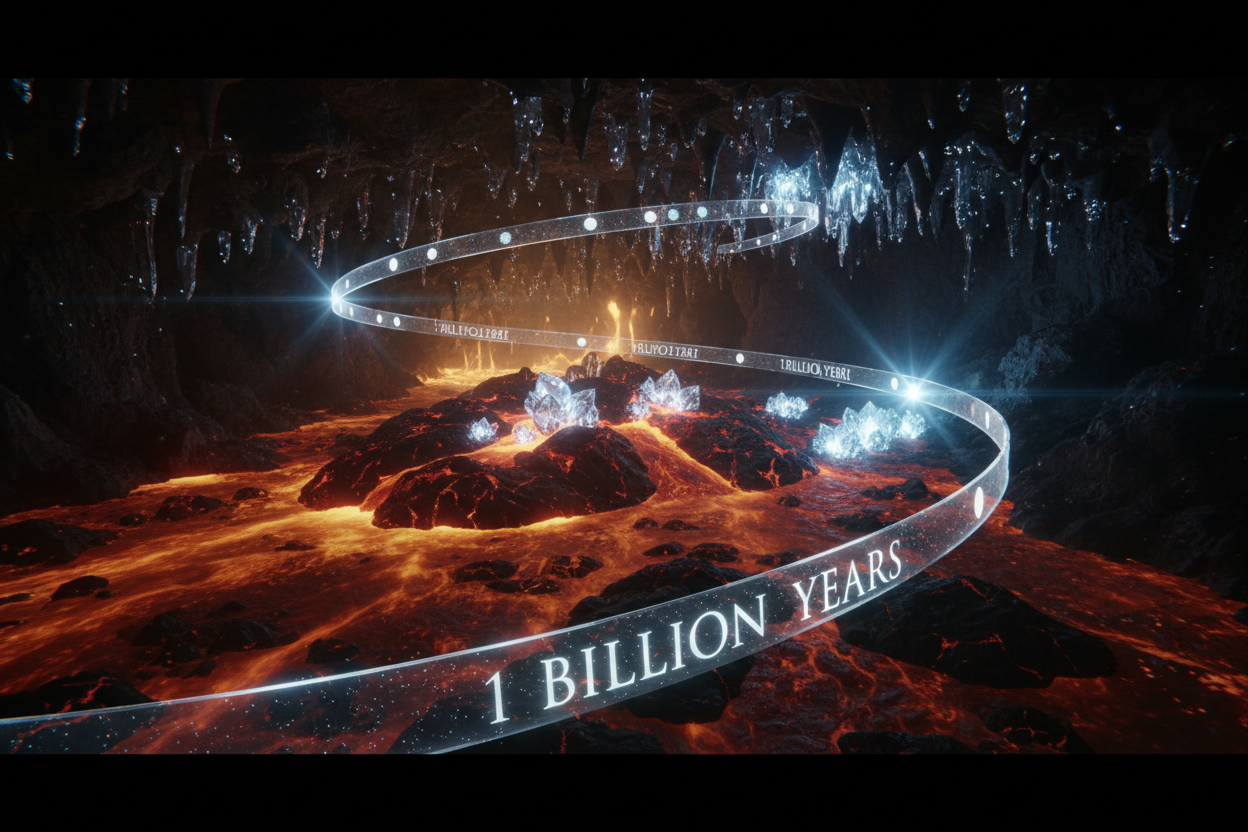
- Most gem-quality natural diamonds are estimated to be between 1 and 3 billion years old - formed long before humans existed.
These deep-Earth crystals stay locked in the mantle until rare, violent volcanic eruptions transport them closer to the surface. These eruptions create vertical pipes of rock - called kimberlite or lamproite pipes - that act as high-speed "elevators," bringing diamonds to mineable depths before they can transform into other carbon forms like graphite.
From Mantle to Mine: The Diamond's Long Journey
Once closer to the surface, diamonds may remain in primary kimberlite deposits or be carried away over millions of years by erosion, ending up in riverbeds and alluvial gravels.
- Mining companies extract ore from open-pit or underground mines, then crush and process huge volumes of rock - often more than a ton of ore to recover a single carat of rough diamond.
- Only a small fraction of rough diamonds are suitable for jewellery; many are used for industrial purposes like cutting and drilling tools.
Gem-quality rough stones then travel to cutting centres, where expert artisans plan, cleave, saw, and facet each diamond to maximise its brilliance. India's Surat hubs roughly 90% of the world's diamond polishing, transforming dull rough into finished, sparkling gems. Every finished stone is graded using the 4Cs - Cut, Colour, Clarity, and Carat - by independent laboratories before being set into jewellery.
This natural journey is awe-inspiring, but it comes with trade-offs: large-scale mining reshapes landscapes, consumes energy and water, and has historically raised concerns around labour practices and conflict regions.
From Mine to Ring: Setting into Jewellery
Once certified, a diamond enters the design stage - set using prong, bezel, pavé, or tension settings in gold or platinum. The finished piece, whether a solitaire ring or a statement necklace, then goes through final quality checks and hallmarking before reaching retail.
Altogether, the full journey from mine to finished ring typically spans one to three years.
The Modern Parallel: How Lab-Grown Diamonds Are Made
Lab-grown diamonds take the same basic ingredient - carbon - and place it into carefully controlled, high-tech environments that replicate or accelerate what happens in the Earth's mantle.
Two main methods are used:
- CVD (Chemical Vapor Deposition): a thin "seed" of diamond is placed in a vacuum chamber filled with carbon-rich gas, often methane. Under high temperature, the gas breaks apart and carbon atoms settle onto the seed, building the diamond layer by layer over several weeks.
- HPHT (High Pressure High Temperature): a diamond seed and a carbon source are subjected to extreme pressure and heat in a press that mimics mantle conditions. Over days to weeks, the carbon crystallises around the seed into a diamond.
The result in both cases is a real diamond with the same crystal structure, hardness, and optical behaviour as a natural diamond. These stones are graded by the same standards and institutions - GIA and IGI - that assess mined diamonds, using the same familiar 4Cs. Lab-grown diamonds are not simulants like cubic zirconia or moissanite; they are genuine diamonds.
Natural vs Lab-Grown: Timeline, Impact, and Value
| Feature | Natural Diamonds | Lab-Grown Diamonds |
| Time to form | 1-3 billion years, plus mining and processing | Weeks to a few months |
| Structure & beauty | Identical carbon lattice, 10 on Mohs hardness | Identical carbon lattice, 10 on Mohs hardness |
| Environmental impact | High - large-scale mining, land and water use | Minimal, no large-scale excavation |
| Ethics | Can carry historical or regional concerns | Conflict-free by origin |
| Price | Premium, driven by rarity and market structure | Generally 40-70% lower in price for comparable quality |
For both natural and lab-grown stones, resale tends to be limited - diamonds are best viewed as emotional and aesthetic investments rather than financial ones.
Xazina's Alternative: Continuing the Story, Consciously
Where natural diamonds tell a billion-year geological story, lab-grown diamonds represent the next chapter - a conscious evolution that keeps the magic of diamond brilliance while updating how it's brought into the world.
Because lab-grown diamonds cost less for comparable quality, you can prioritise what matters most to you: a larger centre stone, better cut and clarity, more intricate settings with halos or side stones, or personalised details like hidden diamonds and symbolic motifs. It's luxury and responsibility, together - ideal for proposals, anniversaries, heirloom-style pieces, and everyday jewellery alike.
FAQs: How Natural Diamonds Form
How long does it take a natural diamond to form?
Most gem-quality natural diamonds are between 1 and 3 billion years old, forming deep in the Earth's mantle long before humans existed.
Are lab-grown diamonds chemically different from natural ones?
No. Both share an identical carbon crystal lattice and score 10 on the Mohs hardness scale - the only real difference is where and how quickly they formed.
Why do lab-grown diamonds cost less than natural ones?
Natural diamonds carry a premium from rarity, extensive mining, and decades of established market structure. Lab-grown diamonds skip that process entirely, which is reflected directly in the price.