


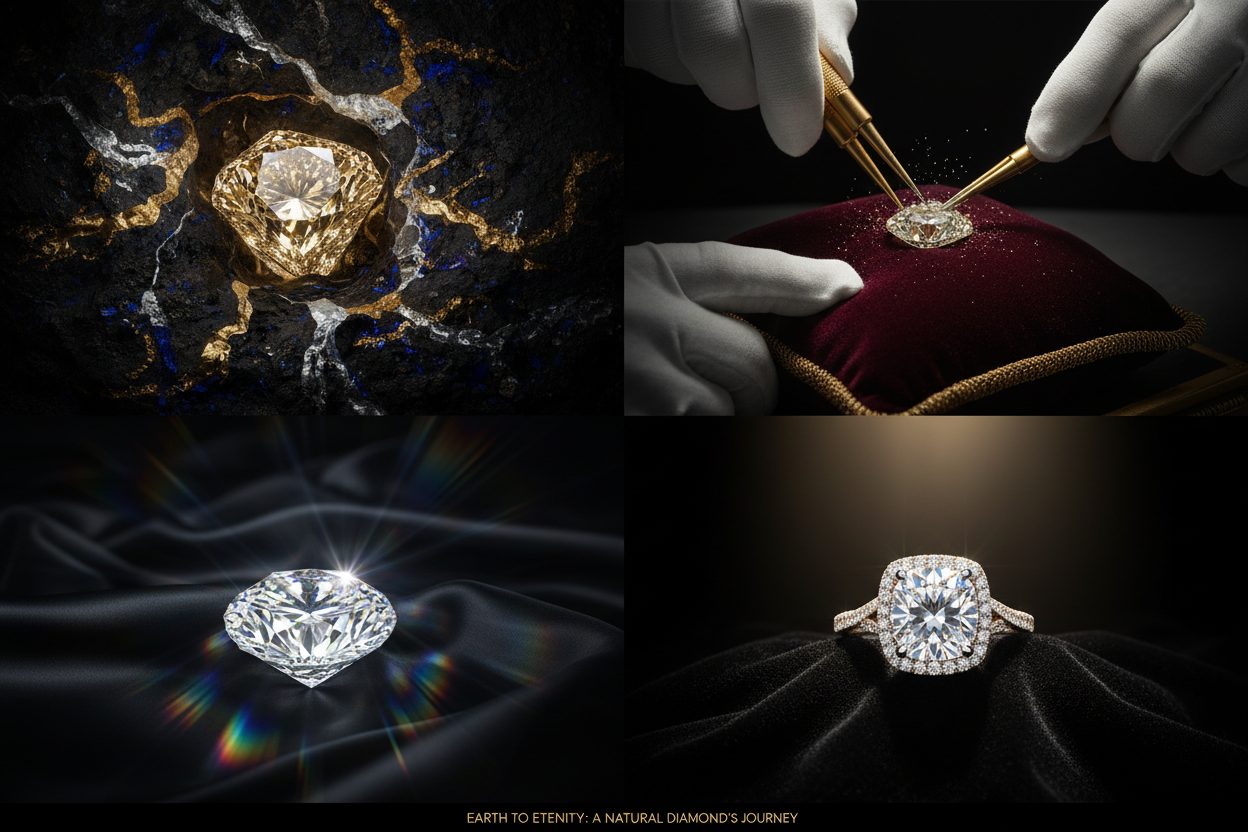
Natural diamonds form deep underground over billions of years, traveling from Earth's mantle to become engagement rings through mining, cutting, and setting. This intricate journey contrasts with lab-grown diamonds' rapid, ethical creation, offering Xazina customers identical sparkle without environmental costs.
Formation Deep in Earth
Natural diamonds crystallize 100-150 miles below surface under extreme heat (900-1300°C) and pressure (45-60 kbp).
Carbon atoms from ancient organic matter form tetrahedral lattices, creating the hardest natural substance.
Volcanic kimberlite pipes erupt them to surface over 1-3 billion years.
Mining and Recovery
Diamonds reach mines via alluvial deposits or primary kimberlite pipes in places like South Africa, Russia, Botswana.
Rough stones (1-2 carats average yield per ton) are extracted via open-pit, underground, or alluvial methods.
Processing crushes ore, uses X-rays/grease tables to separate diamonds, yielding ~20-30% gem-quality.
Cutting and Polishing
Rough diamonds (90% industrial) undergo planning: cleaving, sawing, bruting for shape.
60+ facets are laser-cut/polished over weeks, maximizing brilliance via 4Cs grading (GIA/IGI).
India's Surat hubs 90% of global polishing, transforming dull rough into sparkling gems.
Setting into Jewellery
Certified stones enter design: prong, bezel, pavé, or tension settings in gold/platinum.
Final pieces like solitaire rings undergo quality checks, hallmarking, and retail—full journey spans 1-3 years post-mine.
Lab-Grown vs Natural Journey
|
Stage |
Natural Diamonds |
Lab-Grown Diamonds |
|
Time |
Billions of years |
Weeks/months (CVD/HPHT) |
|
Environmental Cost |
High (mining/water/land) |
Minimal, sustainable |
|
Ethics |
Potential conflicts |
Conflict-free |
|
Cost |
Premium |
30-60% affordable |
|
Quality |
Identical 4Cs/sparkle |
Identical 4Cs/sparkle |
Xazina's Ethical Shortcut
Skip mining's toll with Xazina lab-grown diamonds-same fire, faster path to heirloom pieces.


